 The Perimenopause Husband
Perimenopause Hormones for Husbands: The Simple Version
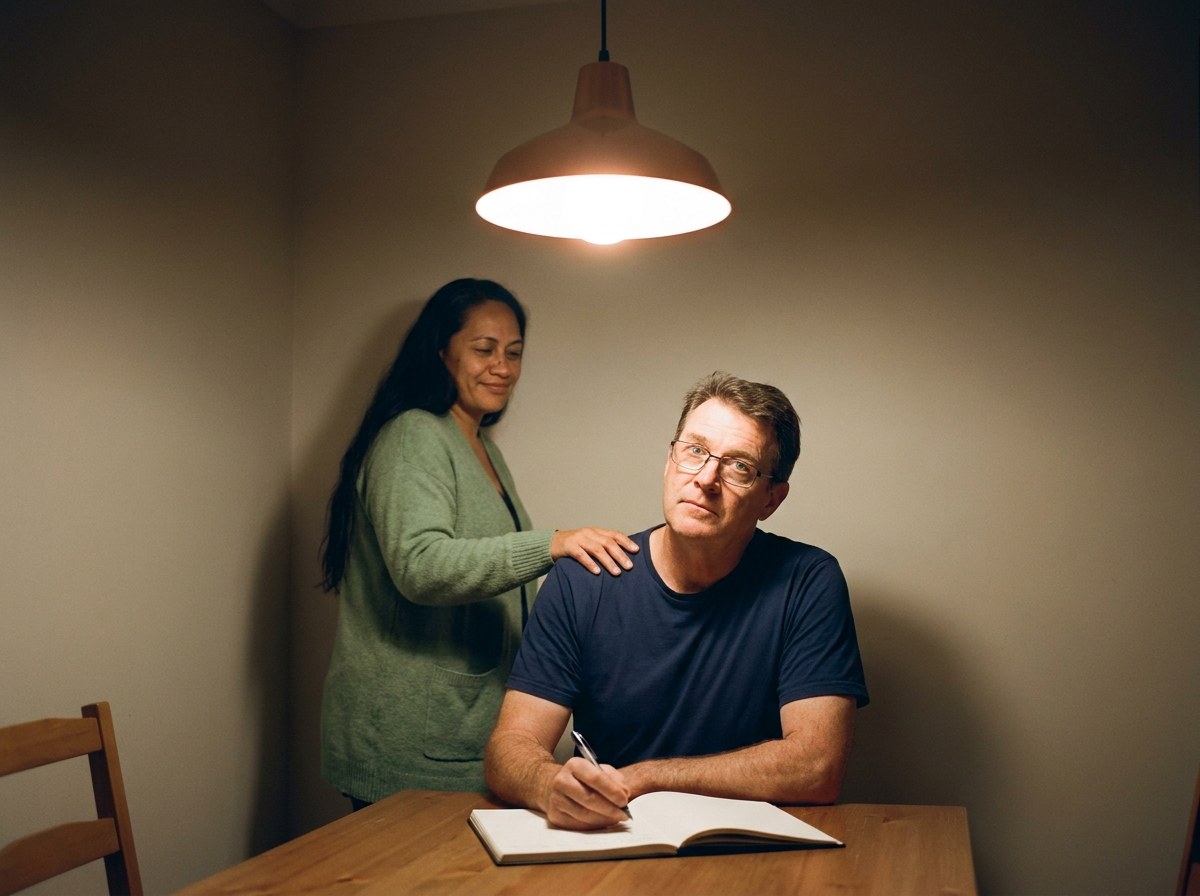
The night I went looking, I found the hormones.
Pages of them. Names, charts, what goes up and what comes down. I read it all, and I'll be honest, it didn't help me one bit. I already knew it was biological. Knowing the names didn't tell me what to do when she walked past me in the hallway with her head down.
So for a long time I kept them out of it. I've changed my mind on that, a bit. Not because the chart matters more than the kitchen. Because a bloke who knows the two names, and what they do, stops saying "it's just hormones" like that's the end of the conversation. It's the start of one.
Here's the simple version. I'm not a doctor, and I'll always keep this side of it simple.
What hormones are involved in perimenopause?
Two of the big ones are oestrogen and progesterone. Behind them sit a few more worth knowing by name, and that's as far as this page goes. Four hormones and one signal. Not a dozen.
Oestrogen is the all rounder. It has a hand in her mood, her memory, her sleep and her body's thermostat. Progesterone is the calming one. It helps her settle, and it helps her sleep. Testosterone, and yes she makes it too, a small amount, sits behind desire and drive. Cortisol is the alarm, the stress hormone every one of us has, the thing that wakes you up and is meant to wind down at night.
And there's a signal. The brain sends a message down to the ovaries every month saying make an egg. That signal is the thing a blood test looks at, and it matters for one reason I'll get to.
For most of her life the two big ones came and went on a schedule. Her body knew what was coming next.
What happens to them in perimenopause?
They stop keeping the schedule.
Oestrogen and progesterone rise and fall with no warning and no pattern. Up one week, down the next, and nothing on the calendar tells either of you which. Over time, they drop. Progesterone, the calming one, slides. Testosterone eases off slowly with age, a slope with no cliff, and that's age, not menopause. Cortisol doesn't drop at all. Its rhythm gets knocked about, mostly by the broken nights, and a body running on alarm sleeps worse again. That's the loop.
And the signal. As the ovaries stop answering, the brain shouts louder, so the signal climbs over the years. But it bounces so much from one day to the next that a single blood test can land anywhere. That's why the doctor didn't just test her and tell you. One reading can't place her in perimenopause. Every authority says the same thing.
That's the whole mechanism, as far as a husband needs it. Now put it next to what you see in the house.
Progesterone, the calming one, goes quiet, and she's lying awake with her mind going. Oestrogen, the one that keeps her temperature steady, drops out, and she's burning up from the inside in the middle of winter. Oestrogen again, the one that keeps her mood level, stops turning up, and an ordinary question gets a short answer. Oestrogen, with its hand in her memory, wobbles, and she walks into a room and forgets why.
Cortisol, the alarm, gets pushed up by the broken nights, and a body running on alarm has a short fuse. Testosterone easing off, and the desire goes quiet, and she can't always explain why.
Put those next to the weather. Cortisol up and progesterone gone quiet is a Storm Warning, one of the five weather patterns we use in our house, the days she's irritable and snapping at things that never used to set her off. The broken nights catching up and the alarm wearing her out by the afternoon is an Overcast day, flat and tired and going through the motions. Oestrogen wobbling on her memory is a Fog day, there but nothing lands. The hormone is the reason. The weather pattern is what you can see from the kitchen.
One more thing a doctor will often check, and it's not a perimenopause hormone. The thyroid runs her engine speed, and when it's off it copies perimenopause almost line for line. Tired, flat, foggy, hair thinning. So does low iron. That's why the first appointment often starts with a blood test for those, to rule them out. Not to prove perimenopause. To make sure it's nothing else.
None of that is her choosing it. None of it is aimed at you.
Is there a perimenopause hormones chart?
Plenty online. Most of them are drawn for her, or for a doctor. This one's ours, drawn for a bloke. The four hormones above, across her life, with the shaded band where perimenopause usually sits.
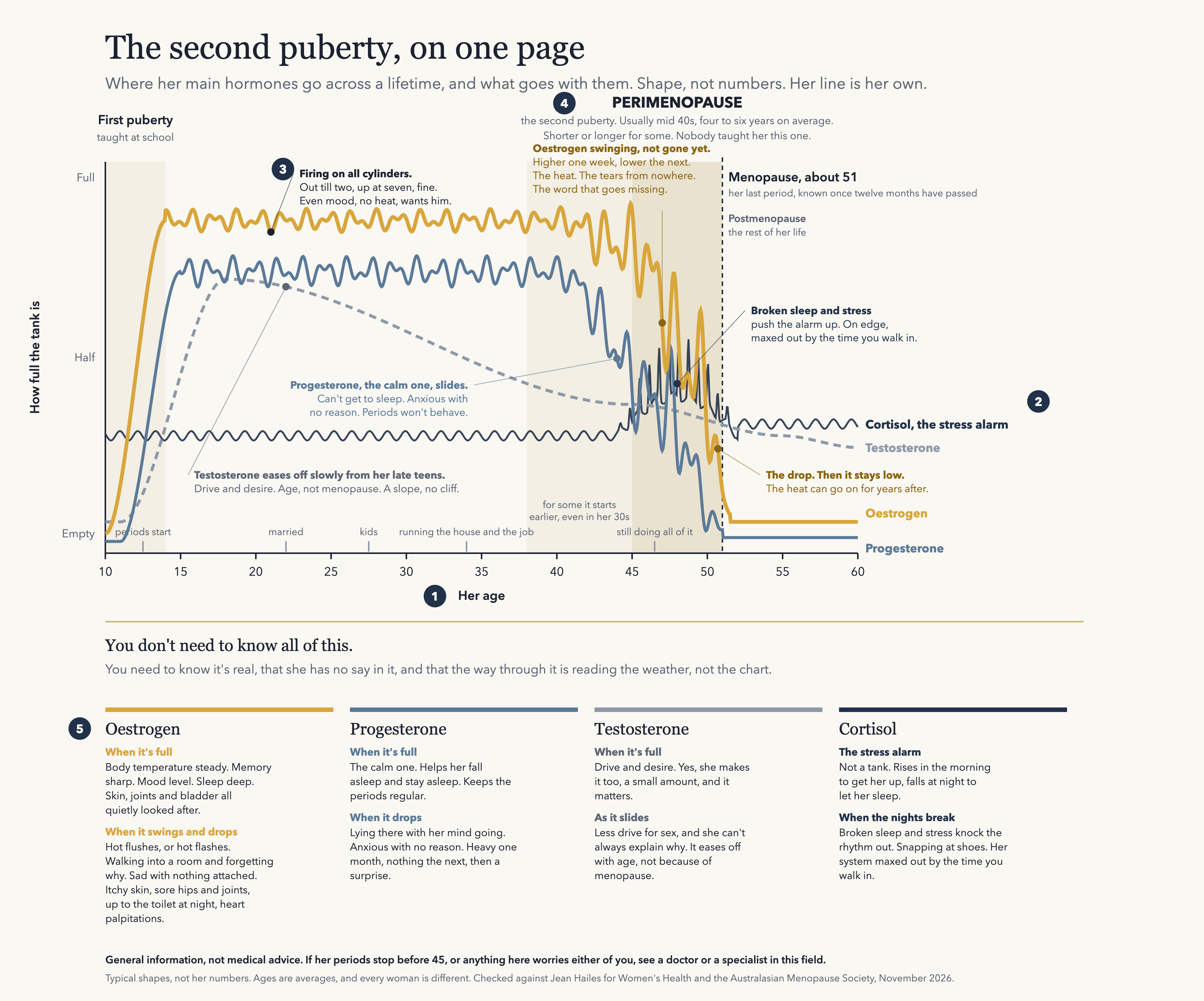
What a chart can't do is read your kitchen. Perimenopause and menopause are two different stretches, and the chart will show you that. It won't show you which of the five weather patterns is in the house this morning. That part is still yours.
Why does any of this matter if I'm not a doctor?
Because it changes what you say.
For a couple of years I thought she'd changed. She hadn't. Two things in the background that had run quietly for thirty years stopped running quietly, and everything I was seeing came off the back of that. Once I knew it, the short answers stopped feeling like a verdict on me.
And it changes what she hears from you. There's a difference between a bloke reciting "it's your hormones" and a bloke who went and found out what that actually means. She can tell the two apart in a second. The second one makes the house feel safer.
Anything medical, levels, tests, what to do about any of it, that's a doctor or a specialist in this field. Go with her, if she wants you there. You now know enough to follow the conversation. You don't know enough to have it for her, and neither do I.
What do I do with this?
Here's one of the tools. There are plenty.
Go and find out. Then tell her you did, and tell her where.
Not a lecture. Not a printout on the fridge. A couple of sentences, on an ordinary day, in your own words. Something like this. I've been reading a bloke whose wife is going through perimenopause. He writes about what it was like in his house, and a lot of it is happening in ours. I didn't know the hormones did all that. It wasn't my intention to make it harder for you. I just didn't know.
That's it. You're not explaining her body to her. She lives in it. You're telling her you went and looked, which is the thing most of us never did, and you're telling her who you're learning from, so she knows it's real and not a guess.
What I do with the knowledge after that, day to day, is in the book. The chapter called Reading the Room is where the hormones turn into a morning.
Is this the only way to understand it?
No. There are a lot of ways to understand this, and this is the plainest one. The autopilot is another, if a picture lands better for you than two names.
Either way, you came and found out. Most blokes don't. Here's where to start with the rest.
Start With the Weather
The Weather Report is the two-page guide to reading these days: telling a storm warning from an overcast day from a fog day, and knowing the one thing to do in each. Free, on your phone in thirty seconds.